Does Your Product Really Need RAG? When Does the Knowledge Base Become Part of the Product?
A clear explanation of RAG, when digital products benefit from it, when databases or deterministic rules are a better fit, and how a knowledge base becomes a real product capability rather than a folder of files.
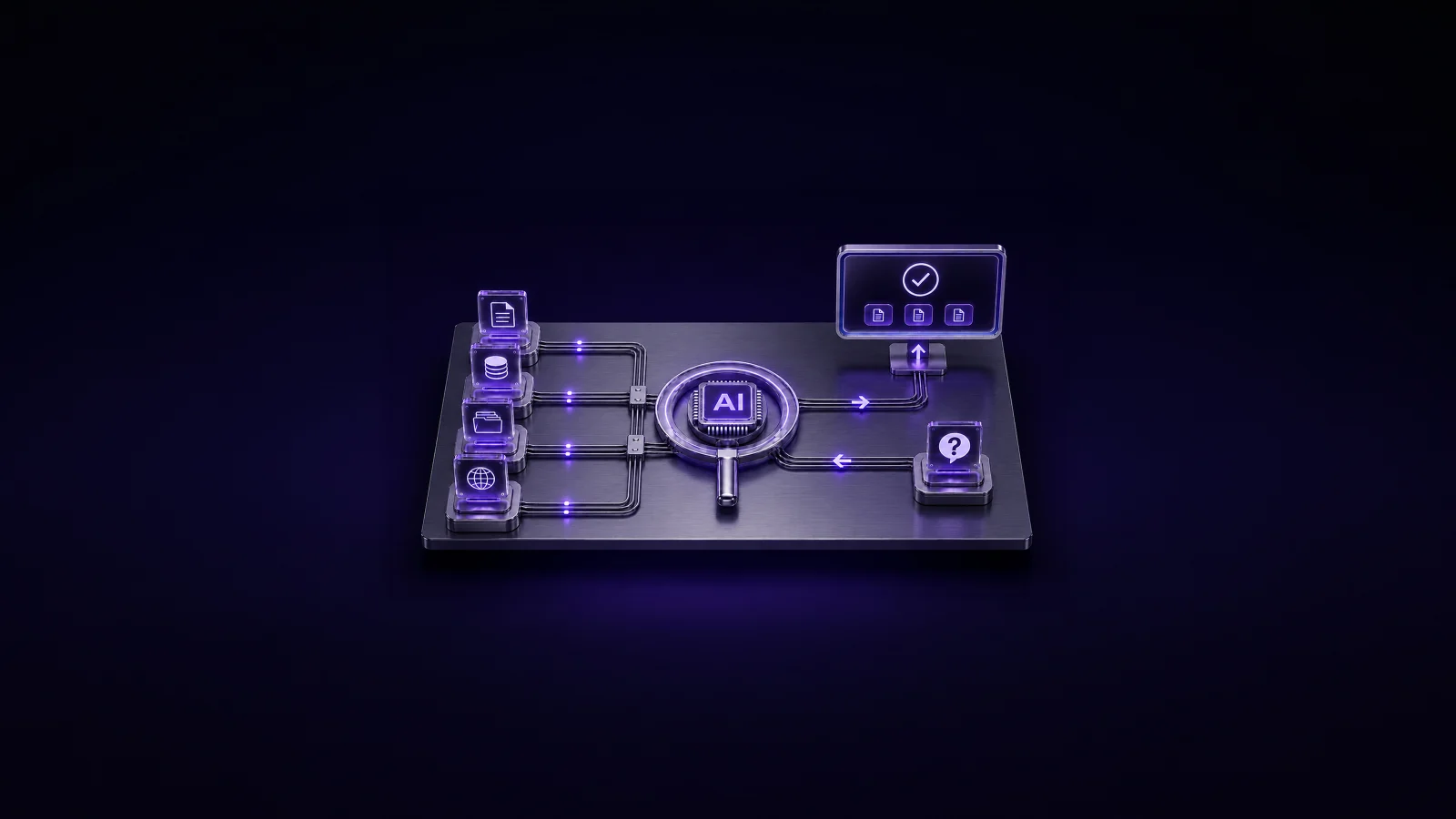
Imagine building a customer-support assistant for an online store. A customer asks, “Can I return a device after opening it?” A general model may produce a convincing answer that does not match the store’s current policy. RAG can help because it allows the product to retrieve the approved policy before generating the answer. The same customer may also ask, “Where is my order now?” That information should not be searched for in documents; it should come directly from the order system. This distinction shows RAG’s real role inside a product: it is a way to use trusted textual knowledge, not a universal solution for every type of data or decision.
What Does RAG Mean in Simple Terms?
RAG stands for Retrieval-Augmented Generation. A simple way to understand it is: “search first, then answer.” Instead of relying only on the model’s general knowledge, the product searches selected sources and places the most relevant information in front of the model before it generates a response.
In the return-policy example, the system receives the customer’s question, searches the store policy, selects the passage about opened devices, and sends both the question and that passage to the model. The product can then show the answer together with the policy link or source name.
RAG does not retrain the model or permanently add the files to its memory. The knowledge remains outside the model and is retrieved when needed. A policy can therefore be updated without training a new model, and the revised version can appear in answers after the knowledge base is refreshed.
When Does a Product Actually Need RAG?
RAG is useful when the product depends on knowledge that is private, large, frequently updated, or unlikely to be known by a general model. Examples include company policies, product manuals, internal documentation, contract templates, research reports, and release notes.
A support assistant can use RAG for warranty policy, return procedures, product specifications, and troubleshooting instructions. This information often lives in text documents, changes over time, and needs to be connected to an approved source.
If the knowledge is very small and static, clear product configuration may be enough. If the user is asking about general public knowledge that does not require a private source, RAG may add cost and complexity without meaningful value.
Do Not Use RAG as a Database or Business-Rules Engine
RAG is designed for textual knowledge retrieval, not as a replacement for a database. Order status, account balance, delivery time, and the current product price are structured, live facts that should come from the responsible system through a database query or API.
RAG should not make a decision governed by a clear rule either. If refund eligibility depends on the purchase date, product condition, and payment method, those conditions should be implemented deterministically. The model may explain the outcome, but it should not invent or inconsistently apply the rule.
Within one product, a return-policy question may use RAG, order status may use an API, refund eligibility may use programmed rules, and exceptional cases may go to a human. This combination is usually more accurate and safer than trying to solve everything through conversation.
A good product does not force one technology onto every problem; it chooses the right path for each type of information.
A Knowledge Base Is Not a Folder of PDFs
Uploading a collection of files is not enough to create a trustworthy knowledge base. Files may contain outdated versions, conflicting instructions, or internal information that a customer should not see. RAG would then search messy knowledge quickly and produce unstable answers.
Each source needs a clear name, an accountable owner, an update date, an approval status, a language, a category, and access permissions. A return policy, for example, may have a customer-facing version and an internal version that explains exceptions; the system must not mix them.
The knowledge base becomes part of the product when an administrator can add, update, retire, and permission a source, then observe the effect of that change on answers. Knowledge is no longer hidden background material; it becomes a managed product layer.
How Does a RAG Pipeline Work Without the Jargon?
The process begins by collecting and cleaning sources, then splitting them into smaller passages. Each passage keeps useful metadata such as source name, section, language, date, and access level. The passages are then indexed in a way that supports meaning-based search rather than exact keyword matching alone.
When a question arrives, the system searches for the passages closest to its meaning, filters them by product, language, or user permission, and may rerank the results to select the strongest evidence. The best passages are sent to the model together with the question.
If the system cannot find enough evidence, it should say so, request clarification, or route the question to a human. RAG does not guarantee accuracy by itself; quality depends on the sources, how they are split, the retrieval process, and instructions that prevent the model from going beyond the evidence.
Test Retrieval and Answer Generation Separately
When a product gives a wrong answer, the problem may be that it failed to retrieve the right source, or that it found the source and used it badly. Evaluation should therefore separate two questions: did the system retrieve the relevant evidence, and did the model produce an accurate answer from it?
Start with real user questions. For each one, define the expected source, the points that must appear in the answer, and the cases in which the system should refuse to answer. Test every update against the same set instead of relying on a successful demo with a handful of questions.
Also monitor citation accuracy, unanswered questions, response time, cost, and employee corrections. Those corrections can become new evaluation cases, allowing the system to improve through measured evidence rather than intuition.
When Does the Knowledge Base Become Part of the Product?
A knowledge base becomes a true product capability when the quality of the experience depends on how it is managed, not merely on its existence. If users rely on answers in their work, source updates, permissions, version history, and gap management become core features rather than technical details.
The product may need a source-management screen, an approval workflow for updates, analytics for unanswered questions, and alerts for stale content. These features are not directly about the model, but they are what make knowledge reliable at scale.
Over time, organized domain knowledge, real questions, corrections, and access rules can become an asset that is difficult to copy. A competitor can use a similar model and index, but it does not immediately gain your curated content, update process, or understanding of the cases your users actually face.
Administrators can manage, update, and retire sources.
Answers change predictably when approved knowledge changes.
Permissions are applied by user, customer, or content type.
Users can see sources and trace why an answer was produced.
Analytics reveal unanswered questions and content gaps.
Not every AI product needs RAG. It becomes valuable when the model needs access to private or changing textual knowledge and when an answer is stronger because it can be tied to a source. Live structured data should come from databases and APIs, deterministic decisions should be implemented in code, and sensitive or novel cases may require a human. Before building RAG, define the sources it will use, who owns them, how they are updated, who may access them, and what the product will do when it cannot find sufficient evidence. When those answers are clear, the knowledge base becomes a real product capability rather than a collection of files connected to a model.